Very happy to announce that my article, "Two Ways of Being at Peace with our Fate and Nature in the Zhuangzi" has (at last!) been published at Philosophy East and West. You can find the abstract below: This article offers an interpretation of anming 安命 or "being at peace with fate" in the Zhuangzi that highlights its heterogeneous understanding... Continue Reading →
A guide to thought and life: Descartes’ “Discourse on Method”
In this week's video, I read through and explain Parts 1-4 of René Descartes' Discourse on the Method of Rightly Conducting the Reason, and Seeking Truth in the Sciences. This is a masterwork of modern philosophy and was extremely influential in setting out the core tenets of rationalism that would guide much discussion of philosophy... Continue Reading →
Giving a talk at Stockton University

I'll be giving a talk on April 12th at Stockton University titled "Truth and Chinese Philosophy," which I am currently co-authoring with Jamin Asay (Purdue University). An abstract of the paper follows: A longstanding debate within comparative philosophy concerns what role (if any) the notion of truth plays in ancient Chinese philosophy. In this paper... Continue Reading →
PGR Overall Weighted Mean and Standard Deviations
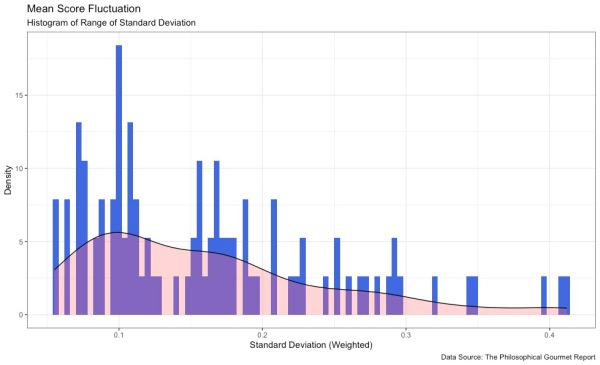
Previously, I calculated the range of overall mean scores of PGR-ranked institutions from 2006-2021. This gave readers a sense of which institutions' scores changed the most over time. However, that analysis was limited in at least two key respects: First, the range is just one measurement of spread of a department's score's spread, and it... Continue Reading →
How to Calculate Weighted Mean and Weighted Standard Deviation with Python
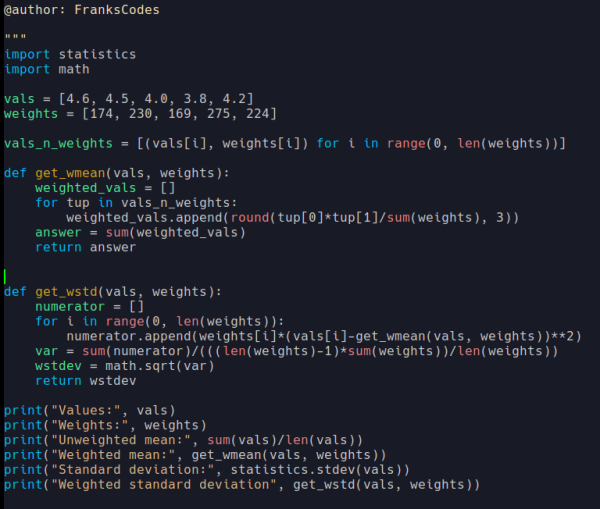
The other day, I had to calculate the weighted mean, standard deviation, and variance of a dataset using Python and I struggled to find reliable guidance that explained how the calculation worked. Here, I'll explain how I performed the calculations using the math and statistics libraries. Why use weighed values? Many of us assign different... Continue Reading →
The PGR’s Biggest Fluctuations in Mean Scores

The following is a brief analysis of the Institutions whose mean scores swung the most since the 2006 PGR. Which Institutions saw the largest change in its overall mean score since 2006? Yale University (2021 overall rank 6) had a spread of 1-point over a cumulative increase in its mean score since 2006, which is... Continue Reading →
Introducing the PGR Database Project

Upon making some progress with my Visualizing the Philosophical Gourmet Report (PGR) project using Excel and Tableau, I've decided to create a relational database of all the publicly-available PGR data and document the process on a new page: The PGR Database Project. The goal of both projects is to increase accessibility and utility of the... Continue Reading →
New Visualizations: Institution Scores by Philosophical Area

One useful comparison the PGR data allows us to make is between an Institution's scores within a certain Area of philosophy and its Overall score. However, the data is a bit cumbersome to navigate in table form, and so help improve the raw data's utility, I've added more visualizations for each major Area and a... Continue Reading →
Visualizing the PGR

I decided to try my hand at visualizing the PGR's data about the rankings and specialties of top philosophy programs in the English-speaking world. It was a lot of fun, and hopefully might be useful to somebody. Below is a sample screenshot of the bubble chart showing distributions of potential areas of specialization across the... Continue Reading →
On Truth and Chinese Philosophy
I am pleased to announce that my paper, "Truth and Chinese Philosophy: A Plea for Pluralism" has been accepted for publication in Dao: A Journal of Comparative Philosophy. My first ever published paper was on this very topic back in 2014, also in Dao, and so I'm very excited to be revisiting it in Dao... Continue Reading →
 Analyses by Frank Saunders Jr